Powering Pedals
All about volts, current, batteries and power
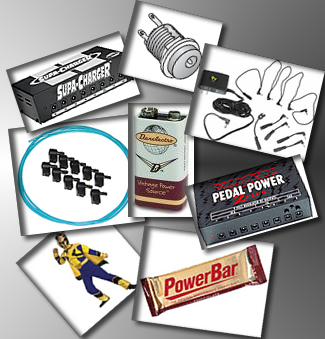
A while ago, I wrote an article about Stompbox Power Internals, mostly to force myself to learn all the intricacies of how power is wired into the typical pedal. As I've worked on building out a pedal board,I've realized that there is a lot more to power than just the battery, wiring, and DC jack inside the pedal. Lot's more. So here is a collection of topics related toPowering Pedals--I hope you find it useful in getting the most out of your pedals and pedalboard.
Some Basic Terms
I get weary and grumpy when I have to read technical stuff that has lots of arcane terms, formulas, graphs n'other assorted stuff. So the last thing I want to do is bore you with the same. On the other hand, there are a few key terms we'll be playing with in this article, so bear with me if you already know them, or don't know them and don't really care to know them.
| Term | Textbook-Type Explanation | Beavis Gross Oversimplifiation |
|---|---|---|
| Voltage | Voltage is the difference of electrical potential between two points of an electrical or electronic circuit, expressed in volts. It measures the potential energy of an electric field to cause an electric current in an electrical conductor. | Voltage is the unit of measure that determines the battery and/or AC adaptor you need to use with a specific stompbox. |
| Current | Electric current is the flow (movement) of electric charge. The unit of electric current is the ampere (A), which is equal to a flow of one coulomb of charge per second. | Current is how much power your stompbox needs. If voltage defines the "type" of power, current defines how much of it. |
| AC/DC | A hard rock band formed in Sydney, Australia in 1973 by brothers Angus and Malcolm Young. All things being equal, pretty much the most awesome band ever. | Alternating Current (AC) is what comes out of the wall outlet. It alternates between a positive phase and a negative phase. Direct Current (DC) is what comes out of a battery or AC-DC adaptor. |
Voltage in the Context of Stompboxes
The majority of stompboxes run on 9 volts, direct current. 9 volts, like most things in life, is a compromise. By that I mean that it is a balance between a convenient battery size (the 9 volt PP3 type battery) and voltage requirements of a typical guitar audio circuit. Is 9 volts ideal? Well, it is fine for typical transistor and opamp-based boosters, fuzzes, overdrives and distortions. But it imposes design limitations on stompbox design, limitations that are sometimes problematic for clean boost, equalization and digital designs.
The first limitation is the amount of headroom available in a stompbox. Headroom is the maximum signallevel a given circuit can reach before compression and distortion set it in. Here's how voltage affects headroom:
A typical circuit uses a voltage divider to set a reference point. This reference point, in very simplified terms, tells the transistor or opampamplifier where the "middle" of the signal is, and is generally set to half the availble voltage. So half of 9volts is 4.5 volts and that value determines how muchheadroom the circuit will have.
Now if you are talking about an overdrive or distortion pedal, then headroom is generally notimportant--you actually want to have the circuit compress and distort, so all is well. But what if youwant a clean boost? You want to amplify the guitar signal without any distortion or compression, so 4.5 volts is not ideal. And this is where we see the compromise between convenience and performance come into play.
For boost, equalization and modulation effects where lots of headroom is important, the stompbox is going to require more than 9 volts. In this case, designers will rely on several voltage augmentation techniques:
|
Technique |
How it Works |
| Two batteries | Run two 9-volt batteries and you instantly have 18 volts--double the voltage and double the headroom. This is a quick fix, but often impractical due to the increased enclosure size and the pain of having to double your battery purchasing budget. Double-battery configurations are pretty rare nowadays, but back in the early days of stompbox design when components weren't incredibly efficient, they were the norm. Look at some of Craig Anderton's designs, or R.A. Penfold's books and you'll see lots of double-battery designs. |
| A bigger AC Adaptor | Another approach to increasing voltage is to dispense with battery power altogether and supply an higher-voltage (typically around 12 volts - 18 volts) adaptor. This solves the headroom issue rather nicely, but forces the stompbox to require its own dedicated power source. |
| A Charge Pump | A charge pump is a device that uses capacitors to boost voltage. A common charge pump devices used in stompboxes is the Maxim MAX1044 device--it is a chip that can boost voltage range to allow more headroom. There are also add-on devices like the Godlyke Voltage Converter which use charge pumps to increase voltage range. |
Batteries
The standard stompbox battery is the 9 volt PP3 configuration battery.
But what about battery types? Dry-cell, alkaline, rechargeable? There are lots to choose from, but only a few options that make sense in the context of stompboxes. First, let's look at the capacity ratings of different types of 9 volt batteries:
|
Battery Type |
Typical Capacity in mAH |
| Alkaline | 500-550 |
| Carbon-Zinc | 400 |
| Lithium | 1200 |
| NiCd nickel-cadmium rechargeable | 120 |
| NiMH nickel-metal-hydride rechargeable | 175-300 |
| Lithium polymer rechargeable | 500 |
Capacity is measured in milliampere-hour (mAH) which basically tells you the amount of steady current passed by the battery on one hour. You can see from the above chart that alkaline batteries provide more juice than standard carbon-zinc, but way less that Lithium. Unfortunately, lithium batteries are quite expensive and are not practical for stompboxes from a cost perspective.
Additionally, rechargeable batteries deliver abysmal mAH ratings compared to disposable ones, and are also inconvenient (who wants to keep popping the battery cover and yanking batteries? Not me.)
In general, alkaline batteries are the best types for stompboxes in terms of longevity. You can certainly get away with carbon-zinc, but they'll croak faster and at a more non-linear rate.
Which leads us to:
Never Buy Batteries at the Store
The markup on batteries at retail locations is unbelievable. You will typically see around 4 dollars for a name-brand alkaline 9 volt, and that is absolute insanity. Retail stores have a huge profit margin on batteries--don't play their game.
Instead, buy your batteries online through a bulk distributor. For example: a 9 volt alkaline Duracell for $1.50.
Finally, if you have to byy retail, get your batteries at a place like Costco or Price Club. Great bulk savings to be had there.
Which leads us to:
Skip Batteries Altogether
If you are serious about using effects and have, or are building, a pedalboard, ditch the battery equation altogether and go with AC-DC adaptors. We'll talk a bit more about this later, but for now, just add up the hundreds of dollars you are paying to retail stores for overpriced batteries that die and then get dumped in a landfill leading to toxic waste that will eventually lead to the zombie walking dead mutation apocalyptic scenario.
Over-Volting and Under-Volting
"Wait!" you may say. "Those are made-up terms!" Well you got me there. But they are convenient monikers to use when talking about two interesting aspects of voltage modification for pedal use.
Sometimes, folks will run 9 volt pedals at higher voltages using an AC-DC adaptor. For example, you may take an overdrive pedal that is nice, but when you boost it up to 12 volts you find that it sounds a lot better. Why is that? Because of headroom, as we discussed earlier. Increased voltage gives the pedal more usable headroom. It is interesting to experiment with over-volting pedals, but only within the following constraints:
- Ensure the pedal can support more voltage. Before you plug the pedal into an hopped-up adaptor, check with the manufacturer for the rated maximum voltage. Don't assume that it will work. Assume that it will fry the pedal.
- Over-volting is only useful on analog pedals. Analog pedals primarily use transistors and/or opamps to accomplish their magic. These analog devices are amenable to over-volting to increase headroom. Digital circuits expect what they expect or they refuse to work. Over-volt your Line 6 DSP pedal and at best it will just shut down, at worst it will become an ex-pedal.
Next, on to under-volting which is also known as "voltage sag". Some folks feel that certain pedals sound better when the battery is dying. This is common for fuzz, overdrive and distortion circuits. Why would a dying battery sound "better"? If you remember our discussion about headroom, it will be pretty bvious. Asthe battery becomes depleted, its available voltage and current decrease. This in turn decreases headroom and adds more compression and distortion.
Of course, waiting for you battery to achieve thegolden state of "mostly dead"-ness is hardly practical. So you can build a dying battery simulator, or use the Sag feature of a commercial power unit to achieve the same affect.
As with over-volting, under-volting does not make sense in the context of digital pedals. They are binary beasts, either the voltage is right or it isn't.
Current Draw
So enough about voltage already. What about current?Why is it important?
Each pedal is going to draw a specific amount of current out of the power source, whether that source is a battery or and AC-DC adaptor. A high current draw is going to deplete your battery faster. A higher current draw is also going to require a heftier AC-DC adaptor.
To put things in perspective, let's look at some examples of common pedals and their current draw:
|
Category |
Pedal |
Current Draw |
| Common analog transistor/opamp designs | ZVex Box of Rock | 3mA |
| Ibanez Tube Screamer | 6mA | |
| Boss BD Blues Driver Overdrive | 13mA | |
| Digital/DSP based single pedals | Boss PS5 Super Shifter | 50 ma |
| Boss DD-5 Digital Delay | 65mA | |
| Multi Pedal/Effects | Boss ME 50 multi-effects | 140mA |
| Boss Twin Pedals (i.e. DD-20 delay, etc.) | 200mA |
As we start out at the top, we can see that analog designs based on transistors and opamps have rather miserly requirements in the range of 3mA to 15mA. These types of pedals can last quite long with a battery. But as we move up the food chain, we can see the pedals become increasingly greedy.
Indeed, for most pedals that draw 100mA or more, batteries are very impractical. In the user guide for the Boss DD-20 GigaDelay, it explains how to install 6 AA batteries, but then goes on to tell you these are for "testing purposes" only.
In today's world of increasingly complex stompboxes, and with the growing ubiquity of digital/DSP designs, battery usage is often not advisable. However, if even if you use AC adaptors, you still need to understand current draw, as we'll see when talk about AC-DC adaptors and power supplies.
How to Measure Current Draw
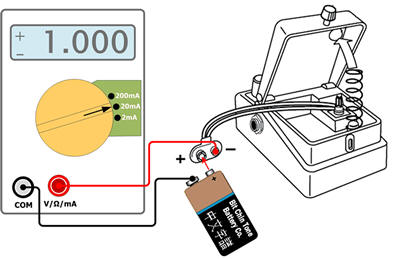
As you work through the powering issues associated with stompboxes and your pedalboard, you'll eventually need to know the current draw for your pedals because you'll want to ensure that your total draw is not exceeding your available power. You can search the interwebs for manufacturer's published current draw values for your specific pedals, but where's the fun in that? The most accurate numbers are going to come from your actual pedals, so knowing how to measure current draw is an important skill, and will also make you more attractive to women.
The good news is that it is very easy to do. First, get out your multi-meter. (What? You don't have a multi-meter? Get one post-haste. Being a serious pedal user/hacker/builder without a multi-meter is like being a duck and not having lips. Or something like that.)
- Insert a plug into the pedal's input jack so it
is powered on
- Press the stompswitch so the pedal is on.
- Pop open the pedal so you have access to the
battery clip
- Connect only the positive side of the battery
- Set your multi-meter to read mA values in the
2-200mA range
- Connect the meter's probe in series with the
battery and battery clip
- Measure the current draw
Pedals without Batteries
You can measure current draw on pedals without batteries also--it is just a bit more work. Use some wire, a DC jack and a DC plug. Like this:
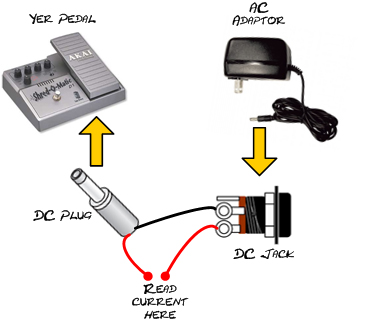
It really is that simple. You might want to keep a list of all the measured current draw values for your pedals--these numbers will come in useful later if you are figuring out overall power requirements.
AC-DC Adaptors
An AC-DC adaptor is the wall-wart type device that you plug into the wall. It uses a step-down transformer to convert the mains voltage (120vAC here in the U.S., 240vAC overseas) down to a much lower value, typically anywhere from 3 volts to 40 volts. It then uses additional components to convert (or rectify) the AC into DC.
Unregulated Cheap Slop
Unregulated adaptors are based on primitive designs, and consequently, dirt cheap. The primitive cheapness comes into play in the part of the adaptor that converts AC into DC. With unregulated power supplies, a multi-diode configuration known as a bridge rectifier is responsible for the conversion. It is simple and cheap, but it is not ideal. Indeed, some double-cheap models don't even do a full bridge rectifier--two diodes is the minimum instead of four in this case.
First off, on an unregulated supply, the conversion from AC to DC does not result in pure DC. There is always some residual AC hanging out on the DC signal. This residual dirt is known as ripple and manifests itself in an audio circuit as noise.
Another drawback of an unregulated supply is that it will only deliver its rated voltage at a certain stated load.
Try this for fun: take the cheapest AC-DC adaptor in your collection. Read the output voltage rating, let's say that it is 12vDC. Plug it into the wall and use your multi-meter the check the output voltage. WTF? It is something like 14 volts. That is because an unregulated supply rated at 12 volts will only actually put out 12 volts when it has a load connected (like a pedal) that draws the exact current that the supply is rated for. This is generally not a terrible thing, but it leads to a lot of slop in the power supply's ability to provide the correct voltage to its user.
Finally, unregulated power supplies also generally lack any kind of filtering of other crap that may be on your mains. For example, mains-carried RFI and other mid to high frequency noise is not filtered out.
So, unregulated supplies are crap, but chances are that you own a lot of them. The good news is that most pedals have circuitry that does at least rudimentary filtering so noise and hum are reduced but typically not eliminated.
Regulated Power Supplies
Regulated power supplies (also known as switching power supplies) on the other hand are very nice. They use semiconductor-based AC-DC conversion and have at least adequate filtering. The resulting DC output is mostly devoid of residual AC ripple (less noise) and actually puts out the stated voltage regardless of load (better circuit stability).
So What Do I Use?
If you are like me, you have a box or drawer full of shitty AC-DC adaptors culled from a variety of broken, lost or obsolete devices. You keep them around and when you need power for a pedal, you dig through your box and try to find a match for voltage, current and tip polarity. And invariably, you end up with problems.
In an ideal world, you would use only high-quality regulated power supplies, and to the extent possible (as dictated by your budget), you should try to do this. Unregulated mystery supplies will add noise to your chain and you can never be sure about the actual voltage values being presented to your pedals.
The most common good-quality regulated power supply for pedals is the venerable Boss PSA-120, which provides 9.6 volts of regulated, filtered supply.
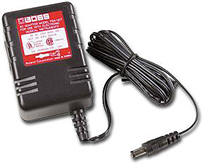
It can supply up to 200ma of current which will handle most of your single pedal needs. They are under 20 bucks a piece and are as reliable as all the other Boss products (which is pretty damn good). Of course, if you have 20 pedals, you'll be forking over around 400 dollars for AC-DC adaptors, at which point you want to start thinking about multi-supply units and daisy-chaining.
Power Supply Connectors
A particularly infuriating part of using AC-DC adaptors is the mismatch of connector types you'll find. Fortunately, the effects world has, for the most part, standardized on the Boss style 2.1mm barrel plug with a negative tip orientation.
Various problems are there to confront you. Here are the most common gotchas and how to address them.
Unknown Polarity
You have an AC adaptor with what appears the right barrel type connector, but you aren't sure it has the correct negative tip orientation for your Boss-style pedal.
Solution: First, check the label on the adaptor. Often there is a small graphic that shows the polarity. Like this:
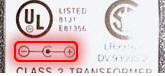
f there is no graphic, you'll have to test the adaptor. Get out your multi-meter and plug the adaptor into the wall. Then stick the red meter lead on the barrel and the black lead in the tip. If it reads a positive voltage value, you have the correct polarity. If the meter shows a negative voltage, it is not the correct polarity for standard negative tip pedals.
Wrong Polarity
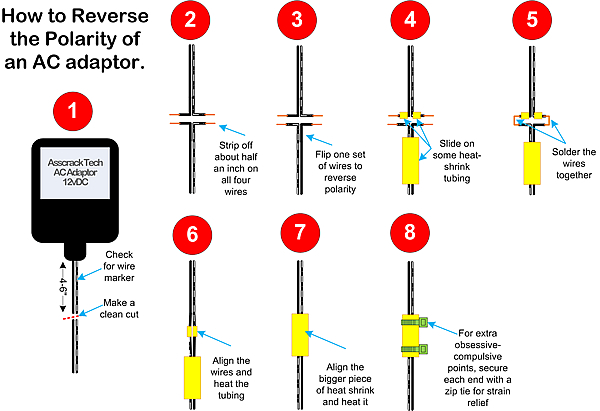
You have an AC adaptor with the correct voltage, current and connector size, but it is the wrong polarity.
Solution: Take your wire cutters and snip the cord about four inches from the base of the AC adaptor. Strip all four wires (two on each one). Twist them together, solder them, and wrap the whole thing up in electrical tape. For a better (and longer lasting) job, use heat-shrink tubing on each wire and then more on the finished job.
Wrong Tip
You have the right voltage and current, but the tip is the wrong type or size.
Solution: As with the previous example, you are going to cut off the plug and wire in a new one. In this case, you'll want to cut the plug off at around 4 to 6 inches from the plug end of the wire. Cut the old plug off, connect the new one, solder the wires (be sure to observe the correct polarity) and add some strain relief.
Building Your Own Daisy Chains
So let's say you have a multi-supply unit like the Pedal Power 2. Six of the outputs are rated at 100mA and two are rated at 200mA. If you measure the current draw of your pedals you will likely find that you have quite a few pedals that draw less than half of the 100mA current maximum.
Logically, you can power multiple pedals from one DC outlet as long as the total current draw for those pedals doesn't exceed the 100mA. It is always a good idea to leave yourself a little wiggle room, so 3/4 of the total power would be better. Let's assume the following scenario
| Available current | 100mA |
| Pedal 1 current draw | 20mA |
| Pedal 2 current draw | 20mA |
| Pedal 3 current draw | 60mA |
So you have 100mA to work with. Some quick math shows that the combined current draw of 1, 2 and 3 is 100mA so you could theoretically daisy chain those three. Well-built units will handle that, but if you have a suspect adaptor, keep it to 3/4: i.e. only power 1 and 2, 1 and 3, or 2 and 3 from the same output.
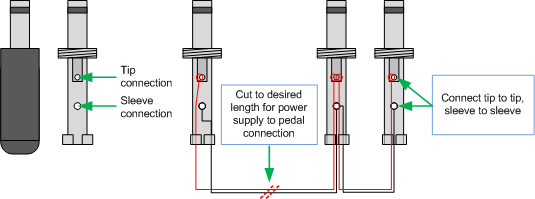
Once you have calculated all the current draw figures and determined the permutations of multiple pedals to be powered from one port, it's time to get some daisy chain cables. You can buy them, but that will make you less cool, so why not build your own. Get some zip wire and 2.11mm DC connectors and follow the diagram below:
Living with Line 6 Pedals
No discussion of power supplies would be complete without at least some discussion of Line 6 pedals and their quirks and issues. For convenience, I'll split the topic into ToneCore pedals and Stompbox Modelers (DL4, DM4, FM4 and MM4).
The ToneCore Series
-
The ToneCore series are digital pedals, but they do conform to the Boss standard: 9vDC adaptor into a 2.11mm negative tip supply.
-
Like all digital pedals, batteries probably won't last too long, so use an adaptor. (See Line 6 Noise, below)
-
Their recommended adaptor is the DC1 9.6v regulated power supply, 60ma, tip negative, but any standard Boss adaptor will do.
Stompbox Modelers
The Stompbox Modeler Series is sold with 9vAC adaptors. Wait a minute! AC? Yep, the suggested Line 6 adaptor for the stompbox modelers is the PX-2 power supply with an output of 9vAC at 2000mA. Why is that? Well Line 6 is a big company and for efficiency it is a good idea to have a single power supply unit that can power as many different devices as possible. So having an AC output device means that any device that requires AC gets it, and any device that requires DC can do the AC-DC conversion on its own.
So do you have to use the Line 6 9vAC adaptor? Not really. Both the Visual Sound OneSpot and the Voodoo Labs Pedal Power 2 support the Stompbox Modeler series with simple DC outputs. The Pedal Power 2 has two designated output jacks and DIP switch settings for Stompbox Modelers, so check the user guide before plugging in. Both units require a special cable to work with the Stompbox Modelers.
Line 6 Noise
Digital pedals in general, and Line 6 stuff in particular, can cause power supply noise that is a big problem with multi-pedal setups. In general, if you power your Line 6 gear with non-isolated power supplies (like a Visual Sound OneSpot) there is a good chance you are going to get noise in your other pedals, typically manifested as buzz or hum. This is because any supply line noise generated by a pedal is going to be interjected back into the power supply unit. If the power supply unit is not isolated, it is going to happily pass that noise on to all the other pedals.
So, if you use a non-isolated supply and are having noise with digital pedals, you are going to have to do one of two things:
-
Power each of the digital pedals with its own dedicated AC-DC adaptor
-
Switch to an isolated power supply like the Voodoo Labs Pedal Power 2.
Parts and Supplies
Here is a list of parts and supplies to help out with your pedal power projects.
|
Parts, Supplies, and Hardware |
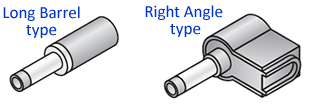
2.11mm Barrel ConnectorsThese are the standard Boss-size DC power connectors you'll find on most pedals. Useful for building daisy-chains and fixing or modifying existing AC-DC adaptors. There are two basic form factors: Long barrel and right angle. Long barrel can be found just about anywhere. The right angle ones are especially nice for tight pedalboards--they take up less space than the long barrel designs.
Long Barrel Kobiconn
Right Angle Kobiconn |
2.11mm DC JacksIf you need to replace or repair a DC jack, there are several part types you can use. For almost all pedal type projects, you'll want to use plastic instead of metal since most pedals are negative ground.
|
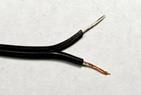
Low Voltage WireYou can use standard #22 gauge zip cord wire for pretty much all your pedal DC power wiring needs.
|
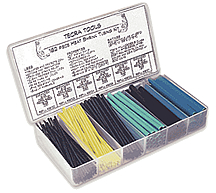
Heat Shrink TubingGreat stuff for strain relief and insulation on DC power cord projects. You can buy it by the foot or get assortment boxes. In my experience, the 3M offerings are very good.
|
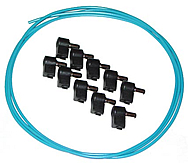
Pedal Power Wiring KitsEffectsConnection sells a nice little kit containing right-angle power connections and some nice blue wire. If you have a bunch of DC patch cables to make, this is a good buy.
|

Recommended Reading
- Jack Orman's
Boosters and Distortion for some interesting
reading on headroom, compression and distortion.
- Build Your own 60mA Power Supply! From Super Cool Smallbear. Or better yet, build your own 20ma Power Supply!

This work is licensed under a Creative Commons Attribution-NonCommercial-ShareAlike 4.0 International License.